
 |
## Features
**Mail**
- Gmail-style three-pane layout (reading pane right/bottom/off, **drag-to-resize splitter** in both orientations, quick layout switch in the list menu), conversation view with collapsed messages and "show quoted text", dense/cozy/comfortable density, light/dark/system theme with accent colours
- Virtualised, infinitely-scrolling message list; multi-select (click, ⇧-click, ⌃-click), drag & drop to folders, right-click context menus, hover actions, Gmail keyboard shortcuts (`j/k`, `e`, `#`, `r/a/f`, `g i`, `/`, `?` …)
- Archive / delete / spam / star / mark read / move / labels (IMAP keywords with colours) with **Undo**
- **"Filter messages like this…"** from the message context menu: creates a Sieve rule pre-filled from the sender/list (target folders can be created on the fly), and can **apply it immediately to the existing messages in the folder** (evaluated client-side, actions applied via JMAP)
- Safe HTML rendering: DOMPurify sanitisation inside a Shadow DOM, **remote images blocked by default** with a per-sender allow-list and an optional **privacy image proxy** (like Gmail's)
- Messages sit on a light card by default, untouched as the sender designed them. *Appearance › Apply the theme to messages too* lets them follow the app's light/dark theme instead — plain-text mail always does, and with the option on so does HTML mail that brings no colours of its own; mail that styles itself is still left alone
- Attachments: previews for images/PDF/text, download all, inline `cid:` images, `.eml` export, *Show original*, header viewer
- Invitations: `.ics` parts render as an invite card with **Yes/Maybe/No** RSVP (via `CalendarEvent/parse` + iTIP); `.vcf` parts offer *Add to contacts*; `List-Unsubscribe` one-click
- **Right-click anyone named in a message** — sender, To, Cc, Bcc, Reply-To — to add them to the address book (the contact editor opens prefilled, with the display name split into first/last), edit them if they are already known, write to them, or copy the address
- Search with Gmail operators (`from:`, `to:`, `subject:`, `has:attachment`, `is:unread`, `is:starred`, `in:`, `label:`, `before:`, `after:`, `larger:`, `smaller:` …) plus an advanced-search panel
- Composer: multiple floating/minimised/maximised composers, rich-text editor (formatting, lists, links, colours, images pasted/dropped inline, emoji), plain-text mode, recipient chips with autocomplete from **contacts, the directory (GAL) and recent recipients**, multiple identities with HTML signatures, Cc/Bcc, priority, read-receipt request, templates/canned responses, attachment upload with progress, drag & drop, attachment reminder, **undo send**, autosaved drafts, reply/reply-all/forward with quoting and inline images preserved
- Live updates via JMAP push (EventSource proxied server-side) with polling fallback; desktop notifications, sound, title/favicon unread badge
- A–Z folder list with Inbox pinned on top (other special folders mixed in), subfolders nested and collapsed by default with chevrons in their own gutter so every icon lines up; unread folders are bold (a parent is bold when a subfolder has unread mail); right-click a folder to mark it read *including subfolders*, create/rename/hide/share/empty, quota bar, Outlook-style module bar (Mail · Calendar · Contacts · Files) at the bottom of the pane, multi-account switching for shared accounts
**Calendar** (JMAP Calendars / JSCalendar)
- Month / week / day / agenda views, mini calendar, multiple calendars with colours, show/hide, create/edit/share calendars
- Create events by click or drag, edit everything: all-day, time zones, recurrence (presets + custom rule builder), location, meeting link, description, reminders, status/privacy/free-busy, colour
- Attendees with invitations (`sendSchedulingMessages`), RSVP, and **free/busy lookup** via `Principal/getAvailability`
- **Right-click menus** on events (open, edit, duplicate, colour, category, delete) and on empty slots/days (new event here, go to day/week)
- **Outlook-style colour categories**: named colours managed in Settings, assigned from the context menu or editor; stored as JSCalendar `categories` (+ `color`) so they sync
**Contacts** (JMAP Contacts / JSContact)
- Address books (create/rename/share/default), contact list with search and letter index, full contact editor (names, emails, phones, addresses, org/title, birthday, website, notes, photo), **groups**, vCard import/export, compose-to-contact
**Files** (JMAP FileNode)
- Browse folders, upload (drag & drop), download, create folders, rename, move, delete
**Settings**
- **Dates & times**: language/region (every one of the ~620 locales CLDR has data for, each named in its own language and script), date order (locale default, `22.11.2025`, `22/11/2025`, `11/22/2025` or ISO `2025-11-22`) and 12h/24h clock, applied everywhere — message list and headers, calendar, contacts, files, sessions. The default comes from the locale configured for the account in Stalwart (`x:AccountSettings/get`, falling back to `x:Account/get`), and from the browser where the server will not say; POSIX forms are normalised (`de_DE.UTF-8` → `de-DE`) and script modifiers preserved (`sr_RS@latin` → `sr-Latn-RS`). Numerals follow the locale (`٢٢.١١.٢٠٢٥` for `ar-EG`), except under ISO 8601, which pins date *and* clock to Latin digits. Dates are **entered** through custom pickers in the same format (browsers render `` in their own locale and ignore the page's), with a calendar popover, a time list, keyboard navigation, and lenient typing — `22.11.`, `221125`, `6:23pm` and bare ISO all parse
- **Self-service credentials** in Settings › Security: change your password, manage **app passwords** (a separate password per mail app or device, revocable on its own), and turn **two-factor authentication** on or off by scanning a QR code. Enrolment codes are verified before anything is stored, so a mistyped key cannot lock you out, and switching 2FA on moves this browser's session onto a dedicated app password instead of signing you straight back out. Works against both Stalwart generations: the `x:AccountPassword` / `x:AppPassword` registry objects on 0.16+, and the `/api/account/auth` REST endpoint on 0.15.x (the latter confirmed live)
- **Light and dark** follow the system by default, with a toggle in the top bar for flipping between them and a three-way choice in Settings › Appearance
- Identities & signatures, **Sieve filters** (visual rule builder that round-trips to a Sieve script, plus a raw script editor with server-side validation), out-of-office (`VacationResponse`), folders, labels, templates, notifications, calendar defaults, sessions (sign out other devices), keyboard shortcuts, import/export of settings
**Platform**
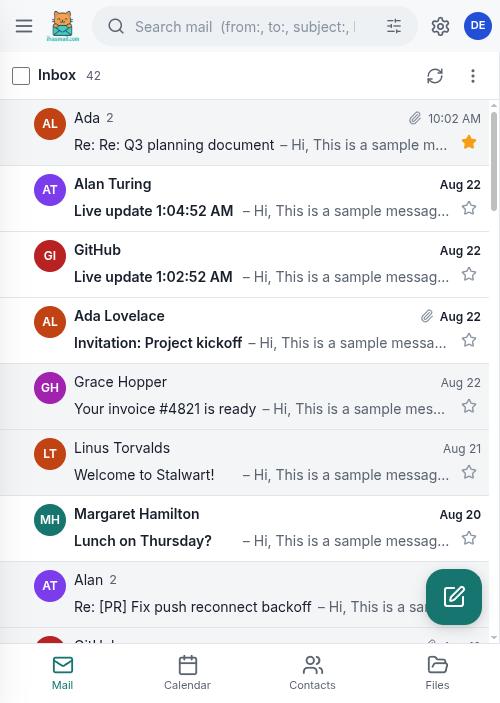
- Installable PWA (manifest + service worker), mobile layout with bottom tab bar, drawer navigation, full-screen composer, FAB
- **Default mail app**: register ihasmail as the browser's handler for `mailto:` links from Settings › General (`registerProtocolHandler`; needs HTTPS and a browser that supports it — Safari does not). Installed as an app it also declares `protocol_handlers` in the manifest, which is what lets the operating system offer ihasmail wherever it asks for a mail client. Links arrive with recipients, Cc, Bcc, subject and body filled in
- **About** reports the Stalwart generation ihasmail detected (0.16+ or older) and the edition where the server gives one. Stalwart does not publish a version number to clients, so no version is shown rather than a made-up one
- Security: no credentials in the browser (server-side session with per-session encrypted upstream credentials), httpOnly SameSite cookies, CSRF header + Sec-Fetch-Site checks, strict CSP, sandboxed blob downloads, SSRF-safe image proxy, login rate limiting, security headers
## Architecture
```
browser ──(same-origin /api/*)──► ihasmail server (Node + Hono) ──(JMAP over HTTPS)──► Stalwart
React SPA • session cookie ⇄ Basic auth
JMAP client + stores • /api/jmap, /api/blob, /api/upload, /api/events (SSE), /api/image
```
- `web/` — Vite + React 19 + TypeScript SPA. `src/jmap` (client, push, types), `src/store` (zustand stores: session, mail, compose, contacts, calendar, files, sieve, settings), `src/views` (mail, compose, calendar, contacts, files, settings), `src/lib` (sanitiser, search parser, Sieve codec, dates and locale-aware formatting, vCard, …).
- `server/` — tiny Node/Hono backend: authenticates against Stalwart's JMAP session endpoint, stores the credentials sealed with a key derived from the cookie secret (the server never persists plaintext passwords), proxies JMAP/blob/SSE calls, serves the SPA with a strict CSP. Also contains `src/mock/` — an in-memory fake Stalwart for local development and demos.
Stalwart capabilities used: `core`, `mail`, `submission`, `vacationresponse`, `sieve`, `contacts`(+`parse`), `calendars`(+`parse`), `principals`(+`availability`), `quota`, `blob`, `filenode`, EventSource push, plus Stalwart's own `urn:stalwart:jmap` (read-only, for the account locale). Features degrade gracefully when a capability is missing.
## Quick start (Docker)
```bash
cp .env.example .env
# edit: STALWART_URL=https://mail.example.com and APP_SECRET=$(openssl rand -base64 48)
docker compose up --build -d
# → http://localhost:8080 (put Caddy/nginx in front for TLS; see Caddyfile.example / nginx.example.conf)
```
Users sign in with their Stalwart mailbox credentials (TOTP codes are supported via the "two-factor code" field, which Stalwart accepts as `password$code`).
## Development
Requirements: Node ≥ 20.10 (22 recommended), npm ≥ 10.
```bash
npm install
# against a real Stalwart (set STALWART_URL in .env or the environment)
npm run dev # server on :8080 (tsx watch) + Vite dev server on :5173 (proxying /api)
# against the built-in mock Stalwart (demo@example.com / demo) — no real mailbox needed
npm run dev:mock # mock on :8788, server on :8080, Vite on :5173
npm run typecheck # tsc for both packages
npm test # vitest (web) + node:test (server)
npm run build # web/dist + server/dist
npm start # serve the production build
```
Open http://localhost:5173 in dev (or http://localhost:8080 for the production build).
## Configuration
All configuration is via environment variables (see `.env.example`):
| Variable | Default | Description |
| --- | --- | --- |
| `STALWART_URL` | `https://mail.example.com` | Base URL of Stalwart; the JMAP session is discovered at `/.well-known/jmap` |
| `APP_SECRET` | *(required in production)* | Secret used to derive session encryption keys |
| `PORT` / `HOST` | `8080` / `0.0.0.0` | Listen address |
| `TRUST_PROXY` | `1` | Honour `X-Forwarded-*` from a reverse proxy |
| `SECURE_COOKIES` | `auto` | `auto` (Secure on https), `1`, or `0` for plain-HTTP dev |
| `SESSION_TTL` / `SESSION_REMEMBER_TTL` | `43200` / `2592000` | Idle session lifetime (seconds), with/without "keep me signed in" |
| `SESSION_FILE` | *(unset)* | Persist sessions across restarts (ciphertext only) |
| `IMAGE_PROXY` | `1` | Route remote images through the privacy proxy |
| `MAX_UPLOAD_BYTES` | `52428800` | Upload size limit (Stalwart has its own limit too) |
| `APP_NAME` | `ihasmail` | Branding |
## Keyboard shortcuts
Press `?` anywhere. Highlights: `c` compose · `/` search · `j`/`k` navigate · `o`/`Enter` open · `u` back · `e` archive · `#` delete · `!` spam · `s` star · `r`/`a`/`f` reply/reply-all/forward · `v` move · `l` label · `x` select · `⇧I`/`⇧U` read/unread · `g i` inbox · `g l` calendar · `g c` contacts · `Ctrl+Enter` send.
## Known issues / pending QA
Verified against the mock server and, for the core mail flows, against a live Stalwart 0.15.5. Still pending live verification:
- **HTML signatures** — Stalwart caps identity signatures at 2 KB. ihasmail compacts pasted HTML, moves images to Files and, if still too large, keeps the full signature in Files behind a short marker (other clients see a text fallback). The end-to-end flow (save → compose → send with inline logo) is implemented but not yet confirmed on the live server.
- **Files** — the live server runs an older Stalwart build than `main`; `FileNode/query` there rejects `isTopLevel`/`parentId` filters, so ihasmail falls back to listing all nodes and building the tree client-side. Upload/rename/move/delete still need a live pass.
- **Self-service credentials** — the **0.15.x REST path is confirmed live** against Stalwart 0.15.5 (2026-08-24): password change, app passwords, and enabling and disabling 2FA, on a real mailbox. The **0.16 registry path has only been exercised against the mock**, which enforces the same rules a real server does (current password required, password policy, a TOTP code on every request once 2FA is on, app passwords exempt from it) — it still wants a pass against a real 0.16 server. Password changes are refused by Stalwart for accounts backed by an external directory (LDAP/SQL/OIDC); the server's own message is shown when that happens.
- Recurring events: colour/category/edit/delete apply to the whole series (per-occurrence overrides aren't supported by the server yet).
- Editable date boxes are always Gregorian and in Latin digits, even for locales whose *display* uses another calendar or numbering system (`fa-IR`, `th-TH`, `ar-EG`) — they keep the locale's field order and separator, but a Buddhist-era year in a text box does not round-trip against the Gregorian calendar grid. Non-Gregorian calendar support is not implemented.
- The account locale is read from `x:AccountSettings/get`, whose permission the built-in user role has, falling back to `x:Account/get` (which needs the admin-only `sysAccountGet`). Both are Stalwart 0.16 methods: **on older servers neither is reachable** — they do not implement the registry and reject a request that so much as names the `urn:stalwart:jmap` capability — so there the locale still falls back to the browser's and can be chosen by hand.
## Roadmap / not yet
- Snooze and scheduled send (needs server-side support)
- Read-receipt (MDN) sending, S/MIME / OpenPGP
- Translations (strings are English-only for now)
## License
Copyright (C) 2026 LINUXexpert.org
ihasmail is free software: you can redistribute it and/or modify it under the
terms of the GNU General Public License as published by the Free Software
Foundation, either version 3 of the License, or (at your option) any later
version. See [LICENSE](LICENSE) for the full text.
|
## Features
**Mail**
- Gmail-style three-pane layout (reading pane right/bottom/off, **drag-to-resize splitter** in both orientations, quick layout switch in the list menu), conversation view with collapsed messages and "show quoted text", dense/cozy/comfortable density, light/dark/system theme with accent colours
- Virtualised, infinitely-scrolling message list; multi-select (click, ⇧-click, ⌃-click), drag & drop to folders, right-click context menus, hover actions, Gmail keyboard shortcuts (`j/k`, `e`, `#`, `r/a/f`, `g i`, `/`, `?` …)
- Archive / delete / spam / star / mark read / move / labels (IMAP keywords with colours) with **Undo**
- **"Filter messages like this…"** from the message context menu: creates a Sieve rule pre-filled from the sender/list (target folders can be created on the fly), and can **apply it immediately to the existing messages in the folder** (evaluated client-side, actions applied via JMAP)
- Safe HTML rendering: DOMPurify sanitisation inside a Shadow DOM, **remote images blocked by default** with a per-sender allow-list and an optional **privacy image proxy** (like Gmail's)
- Messages sit on a light card by default, untouched as the sender designed them. *Appearance › Apply the theme to messages too* lets them follow the app's light/dark theme instead — plain-text mail always does, and with the option on so does HTML mail that brings no colours of its own; mail that styles itself is still left alone
- Attachments: previews for images/PDF/text, download all, inline `cid:` images, `.eml` export, *Show original*, header viewer
- Invitations: `.ics` parts render as an invite card with **Yes/Maybe/No** RSVP (via `CalendarEvent/parse` + iTIP); `.vcf` parts offer *Add to contacts*; `List-Unsubscribe` one-click
- **Right-click anyone named in a message** — sender, To, Cc, Bcc, Reply-To — to add them to the address book (the contact editor opens prefilled, with the display name split into first/last), edit them if they are already known, write to them, or copy the address
- Search with Gmail operators (`from:`, `to:`, `subject:`, `has:attachment`, `is:unread`, `is:starred`, `in:`, `label:`, `before:`, `after:`, `larger:`, `smaller:` …) plus an advanced-search panel
- Composer: multiple floating/minimised/maximised composers, rich-text editor (formatting, lists, links, colours, images pasted/dropped inline, emoji), plain-text mode, recipient chips with autocomplete from **contacts, the directory (GAL) and recent recipients**, multiple identities with HTML signatures, Cc/Bcc, priority, read-receipt request, templates/canned responses, attachment upload with progress, drag & drop, attachment reminder, **undo send**, autosaved drafts, reply/reply-all/forward with quoting and inline images preserved
- Live updates via JMAP push (EventSource proxied server-side) with polling fallback; desktop notifications, sound, title/favicon unread badge
- A–Z folder list with Inbox pinned on top (other special folders mixed in), subfolders nested and collapsed by default with chevrons in their own gutter so every icon lines up; unread folders are bold (a parent is bold when a subfolder has unread mail); right-click a folder to mark it read *including subfolders*, create/rename/hide/share/empty, quota bar, Outlook-style module bar (Mail · Calendar · Contacts · Files) at the bottom of the pane, multi-account switching for shared accounts
**Calendar** (JMAP Calendars / JSCalendar)
- Month / week / day / agenda views, mini calendar, multiple calendars with colours, show/hide, create/edit/share calendars
- Create events by click or drag, edit everything: all-day, time zones, recurrence (presets + custom rule builder), location, meeting link, description, reminders, status/privacy/free-busy, colour
- Attendees with invitations (`sendSchedulingMessages`), RSVP, and **free/busy lookup** via `Principal/getAvailability`
- **Right-click menus** on events (open, edit, duplicate, colour, category, delete) and on empty slots/days (new event here, go to day/week)
- **Outlook-style colour categories**: named colours managed in Settings, assigned from the context menu or editor; stored as JSCalendar `categories` (+ `color`) so they sync
**Contacts** (JMAP Contacts / JSContact)
- Address books (create/rename/share/default), contact list with search and letter index, full contact editor (names, emails, phones, addresses, org/title, birthday, website, notes, photo), **groups**, vCard import/export, compose-to-contact
**Files** (JMAP FileNode)
- Browse folders, upload (drag & drop), download, create folders, rename, move, delete
**Settings**
- **Dates & times**: language/region (every one of the ~620 locales CLDR has data for, each named in its own language and script), date order (locale default, `22.11.2025`, `22/11/2025`, `11/22/2025` or ISO `2025-11-22`) and 12h/24h clock, applied everywhere — message list and headers, calendar, contacts, files, sessions. The default comes from the locale configured for the account in Stalwart (`x:AccountSettings/get`, falling back to `x:Account/get`), and from the browser where the server will not say; POSIX forms are normalised (`de_DE.UTF-8` → `de-DE`) and script modifiers preserved (`sr_RS@latin` → `sr-Latn-RS`). Numerals follow the locale (`٢٢.١١.٢٠٢٥` for `ar-EG`), except under ISO 8601, which pins date *and* clock to Latin digits. Dates are **entered** through custom pickers in the same format (browsers render `` in their own locale and ignore the page's), with a calendar popover, a time list, keyboard navigation, and lenient typing — `22.11.`, `221125`, `6:23pm` and bare ISO all parse
- **Self-service credentials** in Settings › Security: change your password, manage **app passwords** (a separate password per mail app or device, revocable on its own), and turn **two-factor authentication** on or off by scanning a QR code. Enrolment codes are verified before anything is stored, so a mistyped key cannot lock you out, and switching 2FA on moves this browser's session onto a dedicated app password instead of signing you straight back out. Works against both Stalwart generations: the `x:AccountPassword` / `x:AppPassword` registry objects on 0.16+, and the `/api/account/auth` REST endpoint on 0.15.x (the latter confirmed live)
- **Light and dark** follow the system by default, with a toggle in the top bar for flipping between them and a three-way choice in Settings › Appearance
- Identities & signatures, **Sieve filters** (visual rule builder that round-trips to a Sieve script, plus a raw script editor with server-side validation), out-of-office (`VacationResponse`), folders, labels, templates, notifications, calendar defaults, sessions (sign out other devices), keyboard shortcuts, import/export of settings
**Platform**
- Installable PWA (manifest + service worker), mobile layout with bottom tab bar, drawer navigation, full-screen composer, FAB
- **Default mail app**: register ihasmail as the browser's handler for `mailto:` links from Settings › General (`registerProtocolHandler`; needs HTTPS and a browser that supports it — Safari does not). Installed as an app it also declares `protocol_handlers` in the manifest, which is what lets the operating system offer ihasmail wherever it asks for a mail client. Links arrive with recipients, Cc, Bcc, subject and body filled in
- **About** reports the Stalwart generation ihasmail detected (0.16+ or older) and the edition where the server gives one. Stalwart does not publish a version number to clients, so no version is shown rather than a made-up one
- Security: no credentials in the browser (server-side session with per-session encrypted upstream credentials), httpOnly SameSite cookies, CSRF header + Sec-Fetch-Site checks, strict CSP, sandboxed blob downloads, SSRF-safe image proxy, login rate limiting, security headers
## Architecture
```
browser ──(same-origin /api/*)──► ihasmail server (Node + Hono) ──(JMAP over HTTPS)──► Stalwart
React SPA • session cookie ⇄ Basic auth
JMAP client + stores • /api/jmap, /api/blob, /api/upload, /api/events (SSE), /api/image
```
- `web/` — Vite + React 19 + TypeScript SPA. `src/jmap` (client, push, types), `src/store` (zustand stores: session, mail, compose, contacts, calendar, files, sieve, settings), `src/views` (mail, compose, calendar, contacts, files, settings), `src/lib` (sanitiser, search parser, Sieve codec, dates and locale-aware formatting, vCard, …).
- `server/` — tiny Node/Hono backend: authenticates against Stalwart's JMAP session endpoint, stores the credentials sealed with a key derived from the cookie secret (the server never persists plaintext passwords), proxies JMAP/blob/SSE calls, serves the SPA with a strict CSP. Also contains `src/mock/` — an in-memory fake Stalwart for local development and demos.
Stalwart capabilities used: `core`, `mail`, `submission`, `vacationresponse`, `sieve`, `contacts`(+`parse`), `calendars`(+`parse`), `principals`(+`availability`), `quota`, `blob`, `filenode`, EventSource push, plus Stalwart's own `urn:stalwart:jmap` (read-only, for the account locale). Features degrade gracefully when a capability is missing.
## Quick start (Docker)
```bash
cp .env.example .env
# edit: STALWART_URL=https://mail.example.com and APP_SECRET=$(openssl rand -base64 48)
docker compose up --build -d
# → http://localhost:8080 (put Caddy/nginx in front for TLS; see Caddyfile.example / nginx.example.conf)
```
Users sign in with their Stalwart mailbox credentials (TOTP codes are supported via the "two-factor code" field, which Stalwart accepts as `password$code`).
## Development
Requirements: Node ≥ 20.10 (22 recommended), npm ≥ 10.
```bash
npm install
# against a real Stalwart (set STALWART_URL in .env or the environment)
npm run dev # server on :8080 (tsx watch) + Vite dev server on :5173 (proxying /api)
# against the built-in mock Stalwart (demo@example.com / demo) — no real mailbox needed
npm run dev:mock # mock on :8788, server on :8080, Vite on :5173
npm run typecheck # tsc for both packages
npm test # vitest (web) + node:test (server)
npm run build # web/dist + server/dist
npm start # serve the production build
```
Open http://localhost:5173 in dev (or http://localhost:8080 for the production build).
## Configuration
All configuration is via environment variables (see `.env.example`):
| Variable | Default | Description |
| --- | --- | --- |
| `STALWART_URL` | `https://mail.example.com` | Base URL of Stalwart; the JMAP session is discovered at `/.well-known/jmap` |
| `APP_SECRET` | *(required in production)* | Secret used to derive session encryption keys |
| `PORT` / `HOST` | `8080` / `0.0.0.0` | Listen address |
| `TRUST_PROXY` | `1` | Honour `X-Forwarded-*` from a reverse proxy |
| `SECURE_COOKIES` | `auto` | `auto` (Secure on https), `1`, or `0` for plain-HTTP dev |
| `SESSION_TTL` / `SESSION_REMEMBER_TTL` | `43200` / `2592000` | Idle session lifetime (seconds), with/without "keep me signed in" |
| `SESSION_FILE` | *(unset)* | Persist sessions across restarts (ciphertext only) |
| `IMAGE_PROXY` | `1` | Route remote images through the privacy proxy |
| `MAX_UPLOAD_BYTES` | `52428800` | Upload size limit (Stalwart has its own limit too) |
| `APP_NAME` | `ihasmail` | Branding |
## Keyboard shortcuts
Press `?` anywhere. Highlights: `c` compose · `/` search · `j`/`k` navigate · `o`/`Enter` open · `u` back · `e` archive · `#` delete · `!` spam · `s` star · `r`/`a`/`f` reply/reply-all/forward · `v` move · `l` label · `x` select · `⇧I`/`⇧U` read/unread · `g i` inbox · `g l` calendar · `g c` contacts · `Ctrl+Enter` send.
## Known issues / pending QA
Verified against the mock server and, for the core mail flows, against a live Stalwart 0.15.5. Still pending live verification:
- **HTML signatures** — Stalwart caps identity signatures at 2 KB. ihasmail compacts pasted HTML, moves images to Files and, if still too large, keeps the full signature in Files behind a short marker (other clients see a text fallback). The end-to-end flow (save → compose → send with inline logo) is implemented but not yet confirmed on the live server.
- **Files** — the live server runs an older Stalwart build than `main`; `FileNode/query` there rejects `isTopLevel`/`parentId` filters, so ihasmail falls back to listing all nodes and building the tree client-side. Upload/rename/move/delete still need a live pass.
- **Self-service credentials** — the **0.15.x REST path is confirmed live** against Stalwart 0.15.5 (2026-08-24): password change, app passwords, and enabling and disabling 2FA, on a real mailbox. The **0.16 registry path has only been exercised against the mock**, which enforces the same rules a real server does (current password required, password policy, a TOTP code on every request once 2FA is on, app passwords exempt from it) — it still wants a pass against a real 0.16 server. Password changes are refused by Stalwart for accounts backed by an external directory (LDAP/SQL/OIDC); the server's own message is shown when that happens.
- Recurring events: colour/category/edit/delete apply to the whole series (per-occurrence overrides aren't supported by the server yet).
- Editable date boxes are always Gregorian and in Latin digits, even for locales whose *display* uses another calendar or numbering system (`fa-IR`, `th-TH`, `ar-EG`) — they keep the locale's field order and separator, but a Buddhist-era year in a text box does not round-trip against the Gregorian calendar grid. Non-Gregorian calendar support is not implemented.
- The account locale is read from `x:AccountSettings/get`, whose permission the built-in user role has, falling back to `x:Account/get` (which needs the admin-only `sysAccountGet`). Both are Stalwart 0.16 methods: **on older servers neither is reachable** — they do not implement the registry and reject a request that so much as names the `urn:stalwart:jmap` capability — so there the locale still falls back to the browser's and can be chosen by hand.
## Roadmap / not yet
- Snooze and scheduled send (needs server-side support)
- Read-receipt (MDN) sending, S/MIME / OpenPGP
- Translations (strings are English-only for now)
## License
Copyright (C) 2026 LINUXexpert.org
ihasmail is free software: you can redistribute it and/or modify it under the
terms of the GNU General Public License as published by the Free Software
Foundation, either version 3 of the License, or (at your option) any later
version. See [LICENSE](LICENSE) for the full text.